
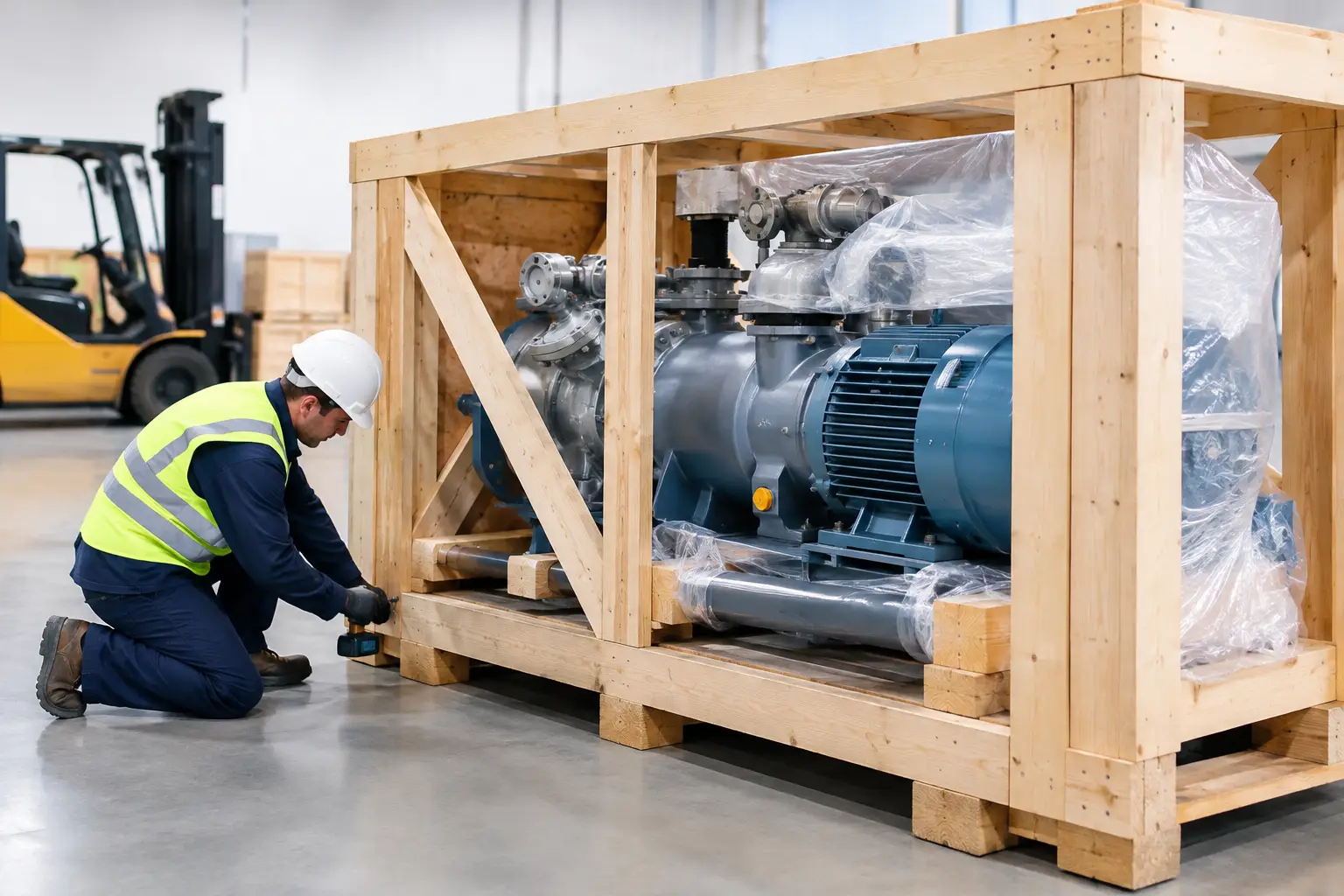
A crated CNC machine, compressor, pump, or production line component may travel by truck, air freight, or ocean container before it reaches its final site. Knowing how to crate industrial equipment correctly is not simply a packing task. It protects valuable assets, helps prevent loading damage, supports safe handling, and gives carriers the information they need to move the shipment without costly delays.
For heavy, irregular, or high-value machinery, a crate must be designed around the equipment, its route, and its handling requirements. A light-duty wood box that works for a small commercial item will not protect a 2,000-pound motor, a sensitive control cabinet, or a machine with an off-center center of gravity.
How to crate industrial equipment safely
Start with the equipment itself, not the crate dimensions. Record the length, width, height, actual weight, and estimated shipping weight after packaging. Identify lifting points, the center of gravity, fragile controls, exposed shafts, doors, hoses, and components that can move during transit.
If the manufacturer provides a shipping manual, follow its instructions for lifting, draining fluids, securing moving parts, and approved tie-down locations. This is particularly important for machinery under warranty or equipment being exported for repair and returned to service.
Before crating, clean the equipment and remove loose debris. For international shipping, visible soil, plant material, oil buildup, or untreated organic material can create inspection issues. Drain fuel and fluids where required by the carrier or destination rules. Batteries, pressurized cylinders, chemicals, refrigerants, and other regulated materials must be declared and handled under the applicable dangerous goods requirements.
A machine should never be supported by a weak panel, a protruding fitting, or a component that was not designed for lifting. Secure it to a properly sized skid or base using bolts, lag screws, brackets, or engineered blocking. The goal is to prevent both sliding and tipping when the crate is tilted, accelerated, or lifted by a forklift.
Choose the right crate and base
The right packaging depends on the shipment’s weight, value, sensitivity, route, and mode of transport. For local truck freight, an open skid with protective wrapping may be sufficient for durable equipment that is not exposed to weather. For international air or ocean freight, fully enclosed crating is often the safer option because the equipment may pass through multiple terminals, warehouses, and handling points.
A proper industrial crate generally includes a heavy-duty base, vertical framing, cross-bracing, protective panels, and enough clearance around the machinery for blocking and cushioning. The base must support the load without flexing. It should also have forklift entry points that are clearly accessible from the intended sides.
For oversized machinery, a custom-built skid and frame may be better than a standard closed crate. This can reduce total dimensions and freight cost while still giving the equipment the structure it needs. The trade-off is that open-frame packaging offers less protection from moisture, dust, and contact damage. Where ocean freight is involved, enclosed protection, moisture control, and corrosion prevention deserve extra attention.
Do not underestimate dimensional weight. Air carriers often charge based on the greater of actual weight or dimensional weight. A crate with excessive empty space may be physically safe but unnecessarily expensive. The best design balances protection with efficient dimensions.
Use export-compliant wood packaging
Wood crates, pallets, dunnage, and blocking used in international shipping often need to comply with ISPM 15 requirements. This means the wood must be heat-treated and properly marked for international movement. Untreated lumber can lead to customs or agricultural inspection delays, repacking costs, or refusal at destination.
Plywood and certain processed wood products may be exempt, but the rules can vary by destination and by the type of material used. When equipment is moving from Canada or the United States to Europe, Australia, South America, or another international market, confirm packaging requirements before the crate is built. It is far less expensive to use compliant materials at the start than to rebuild a crate after cargo has reached a terminal.
Protect the equipment inside the crate
A crate protects the exterior, but internal securing is what keeps machinery from moving. The equipment should be fastened to the base at approved points, then stabilized with blocking or bracing placed against strong structural areas. Use chocks to prevent rolling, straps or bolts to prevent shifting, and braces to limit side-to-side movement.
Sensitive areas need separate protection. Wrap control panels, displays, switches, and finished surfaces with suitable cushioning material. Cover openings to keep out dust and moisture. Cap hoses and fittings. For equipment with precision components, use shock-absorbing material only where it is appropriate for the load and does not allow excessive movement.
Moisture is a major concern for ocean shipments and long storage periods. Condensation inside a crate can corrode metal parts and affect electrical systems. Vapor barrier packaging, desiccants, corrosion-inhibiting wrap, and sealed protective bags can help, depending on the equipment and transit conditions. A sealed interior should be used carefully, however, because trapped moisture can also become a problem if the equipment is packed while damp.
Photograph the equipment before packing, during the crating process, and after the crate is closed. Keep records of serial numbers and condition. These details support insurance claims if damage occurs and make it easier to verify the shipment at destination.
Mark the crate for safe handling
Clear exterior markings reduce handling mistakes. Each crate should show the shipper and consignee details, package number, gross weight, dimensions, and any required handling instructions. Mark the center of gravity if it is not centered, and show forklift pockets or lifting points where applicable.
Use standard instructions such as “This Side Up,” “Do Not Stack,” “Keep Dry,” or “Fragile” only when they reflect the equipment’s actual needs. Labels are helpful, but they do not replace structural protection. A carrier may need to rotate or reposition freight during loading, so the crate must still be built to withstand normal freight handling.
If the shipment includes multiple crates, number them clearly, such as 1 of 4, 2 of 4, and so on. Include a packing list that identifies what is in each crate. This matters when machinery is disassembled into separate bases, guards, tooling, electrical cabinets, and accessories.
Prepare freight and customs documents early
Crating is only one part of moving industrial equipment. International shipments also require accurate commercial paperwork. A commercial invoice should describe the equipment clearly, including make, model, serial number, country of origin when available, quantity, declared value, and the reason for export. Avoid vague descriptions such as “machine parts” when a more specific description is available.
The equipment’s tariff classification, destination country, sale terms, and whether it is new, used, sold, leased, or being sent for repair can affect clearance. Used equipment may require additional declarations, cleaning certificates, or inspection documentation in some markets. Machinery containing engines, batteries, lubricants, wood packaging, or electrical components can introduce further requirements.
For commercial freight, provide the final packed dimensions and weight before booking. This allows the freight forwarder to select the proper truck, aircraft service, container option, or warehouse handling plan. If the crate is heavy, oversized, or top-heavy, advance planning may be needed for a liftgate, forklift, crane, flatbed, or special loading appointment.
Avoid the most expensive crating mistakes
The most common problems are preventable: using a pallet that is too light, failing to bolt down the machinery, leaving moving parts unsecured, building a crate that is oversized for air freight, or using non-compliant wood for export. Another frequent issue is providing an estimated weight that is significantly lower than the final crated weight. Carriers can reweigh freight and apply additional charges when the actual shipment differs from the booking.
It also pays to consider the destination. A domestic truck shipment may only need basic industrial protection, while a crate traveling by ocean from North America to Europe or Australia may face moisture, port storage, transloading, and a longer transit period. The packaging standard should match the route, not just the first truck pickup.
For complex machinery, getting a freight quote before crating can prevent avoidable redesigns. A logistics provider can review dimensions, weight, pickup access, transport mode, destination requirements, and documentation needs before the equipment is sealed inside a crate.
When industrial equipment has real operational value, the lowest-cost crate is rarely the least expensive shipment. Build and document the crate with the full route in mind, then arrange transport with a team that can take charge of handling, freight coordination, and customs details from pickup through delivery. Get a quote now before packing decisions become transit problems.